


Water Sorter
4.22.86K Reviews
App Specs
- Version
- 1.32.0
- Updated On
- License
- Free
- Downloads
- 1,000,000+
- Developer
- Gimica GmbH
- Categories
- Puzzle
- Platform
- Android, iOS
Screenshots


 Analysis by AppCompare
I approached Water Sorter expecting a simple color-matching puzzle, and that is exactly where its appeal begins. The game gives me a set of containers filled with mixed-colored liquid and asks me to separate each color into its own container. The rule is easy to understand, but the order of every pour matters, so a move that looks helpful can quietly remove the space I need later. That balance makes it a comfortable choice for short breaks while still giving me something to think about.
Developed by Gimica GmbH, this free puzzle game is aimed at Everyone and runs on Android devices using Android 7.0 or later. It has passed the point of being an unknown experiment, with more than a million installs, an average score of 4.2 from roughly sixteen thousand ratings, and about three thousand written reviews. Those figures suggest a broad audience, but they do not mean every puzzle fan will enjoy it equally. I found it most satisfying when I wanted a quiet, focused activity rather than a fast game with constant action.
Getting comfortable with the color-sorting idea
The first thing to understand is that Water Sorter is less about matching colors quickly and more about managing empty space. You are not simply looking for two identical colors and combining them. You need to decide which container should receive a pour, whether that move exposes a useful color underneath, and how much room must remain available for later rearrangement.
At the beginning, the board can look more complicated than it really is. Several containers may hold different layers, while a few empty containers give you room to work. I recommend resisting the urge to pour immediately. First, scan the visible top layers and identify colors that can be moved without blocking a color you will need soon. This short pause is often the difference between a clean solution and a board that requires extensive backtracking.
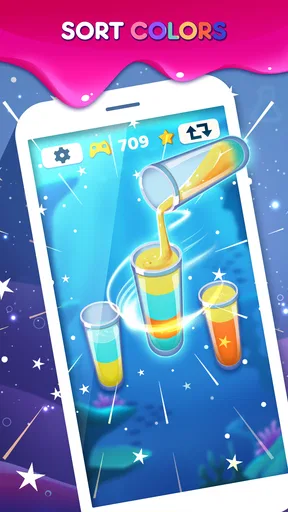
The game’s visual concept is deliberately clear. Each container is easy to recognize, and the colored liquid gives the puzzle a physical quality: you can see the layers, the available capacity, and the consequences of exposing another section. That makes it more approachable than many abstract logic games, especially for someone trying this style of puzzle for the first time.
Still, the simplicity has a limit. If you prefer puzzles built around words, numbers, story clues, or changing objectives, this may feel repetitive. Water Sorter stays focused on the same central action, so its enjoyment depends on whether you like gradually untangling a compact system.
What happens when you install it
Because the game is free, it is easy to try without committing money up front. The current version is 1.32.0, and the listed age guidance is Everyone, which makes it suitable for a wide range of players. I would still describe it as a game for people who enjoy patient decision-making, not merely as something for children. Some boards are gentle introductions, while later arrangements can demand careful planning.
Worth Reading Before You Choose

EA SPORTS FC Mobile 26 Is a Bigger Football Game, but It Takes Time

Flipboard Shows What News Apps Must Do Beyond the Feed

Switching to Android Auto Means Rethinking Your Driving Routine

Google Calendar Makes a Crowded Week Easier to Manage

Ludo King Makes the Most of the Minutes Between Plans

Baby Panda World Brings Quick Play to Modern Phones, but Its Game Library Feels Busy
There are in-app purchases priced from $0.99 to $3.49 per item. That matters if you want an entirely uninterrupted experience or tend to use optional aids whenever a puzzle becomes awkward. I would begin without buying anything and see whether the basic loop works for you. The free entry point is enough to judge the controls, visual clarity, and difficulty style before deciding whether any optional purchase has value.
One practical advantage is that the game does not require you to learn a complicated interface before playing. The core interaction is direct: select a container and choose where to pour. For a first-time user, that means the meaningful part of the experience arrives quickly. You can spend your attention on the puzzle instead of navigating menus.
Your first useful move
My preferred opening routine is to look for a color that is already visible at the top of more than one container. If those layers can be combined safely, doing so may create a larger uninterrupted section and reveal what lies below. I do not treat that as an automatic rule, though. A matching pour is only good when it preserves enough flexibility for the rest of the board.
Empty containers are not just destinations; they are temporary workspaces. A common beginner mistake is to fill one as soon as possible because a completed color feels like progress. Sometimes that is correct, but sometimes the empty space is more valuable than the nearly finished stack. I try to keep at least one flexible container available while I am still uncovering hidden layers.
Another useful habit is to think one pour beyond the move in front of you. Before tapping, ask what the move exposes and where that exposed color could go next. This small mental check prevents many dead ends. It also turns the game from trial and error into a manageable planning exercise, even when the board initially looks crowded.
For a realistic everyday example, imagine having a few minutes before an appointment. I can open the game, inspect one board, and make progress without needing to remember a story or coordinate with other players. If I reach a position that needs deeper thought, I can stop and return later with the same visual problem in front of me. That makes it more flexible than a puzzle that demands a long uninterrupted session.
The confusion that catches new players
The most confusing part for a newcomer is usually the difference between a legal move and a useful move. A pour may be allowed because the destination has the same color or enough room, but that does not make it strategically wise. Moving a layer can uncover a color that has nowhere to go, or it can use the only open space needed to separate another group.
I also had to adjust my expectations about completion. Seeing one container become uniform feels like the obvious goal, but finishing a single color too early can make the remaining arrangement harder. I now judge a move by the condition of the whole board rather than by the immediate appearance of one container.
When I make a poor choice, I prefer to retrace the sequence mentally before restarting. The mistake is often not the last pour but an earlier decision that consumed useful space. This is one of the game’s better learning opportunities: it teaches you to identify the first restrictive move instead of blaming the final awkward position.
Players who dislike restarting should pay particular attention to this point. Water Sorter rewards planning, but it may feel unforgiving when a puzzle becomes tangled. If you want a game where every move can be corrected casually, a more forgiving matching game may be a better fit. Here, the satisfaction comes partly from making a sequence work within limited room.
How I approach a difficult board
On a harder arrangement, I divide the board into three types of containers in my mind: those that are nearly organized, those that contain important colors I need to expose, and those serving as temporary storage. This simple classification keeps me from treating every container as equally urgent.
I usually protect a container with a rare top color until I know where that color belongs. Pouring it away just to make the board look tidier can create a problem later. Conversely, a container with a color repeated across several visible tops may be a good candidate for early consolidation, provided the destination does not remove my last useful workspace.
A less obvious technique is to prioritize uncovering layers that are blocking multiple future actions. If one pour reveals a color that can connect two separate groups, it may be more valuable than completing a color that is already mostly organized. This is not always the winning line, but it gives me a better way to compare moves than simply choosing the fullest container.
I also avoid filling the final empty space until I have checked the board’s remaining transitions. A completely filled workspace can look productive while leaving no room to separate mismatched layers. Keeping one container available is often worth more than making a second color appear nearly complete.
Where it fits beside other puzzle games
Compared with match-three games, Water Sorter is calmer and more deliberate. There is no need to chase a rapidly changing board or react to a timer-like rhythm. Every move is visible before I make it, so the challenge comes from sequencing rather than reflexes.
Compared with Sudoku or classic number puzzles, it is more tactile and immediately readable. I can understand the board at a glance without translating symbols into a grid of deductions. The trade-off is that the range of puzzle ideas is narrower. Sudoku offers many kinds of logical relationships, while Water Sorter repeatedly explores the same question: which color should move, and where can it safely go?
It also differs from word puzzles because there is no language barrier in the central task. The colors and containers carry the information. That makes it approachable for players who want a visual puzzle, although anyone with difficulty distinguishing colors may find the experience less comfortable depending on the specific board presentation and their own vision.
For me, the best comparison is with a small physical sorting puzzle. The pleasure is in creating order from a messy arrangement, and the limitation is that the basic form does not change dramatically. If you need story progression, character development, multiplayer competition, or a large variety of puzzle mechanics, this is probably not the right choice.
Who will enjoy it most
I would recommend it to someone who likes organizing tasks, solving problems in stages, or filling a short pause with something that feels mentally active. It works well for players who enjoy looking ahead but do not want complicated rules. It can also be a gentle introduction to planning because the consequences of each action are visible and easy to discuss.
It is less suitable for people who want constant novelty. The same sorting principle remains at the center of the experience, and that consistency is both its strength and its weakness. If you become bored when a game repeats one mechanic, you may appreciate it briefly but not keep it installed for long.
I would also skip it if your main reason for choosing a puzzle game is competition. This is a personal, board-by-board activity rather than a social contest. Likewise, players who want a strong narrative or character-driven motivation should look toward a different puzzle category.
My final way to play it
After spending time with it, I see Water Sorter as a focused, accessible sorting puzzle rather than a game that tries to be everything at once. Its strongest quality is the clear relationship between action and consequence. When I solve a difficult arrangement, the success feels earned because I can trace the solution back through the choices I made.
The main friction is also clear: a single careless pour can make the board feel unnecessarily constrained, and the repeated mechanic will not suit every attention span. I recommend starting slowly, protecting empty space, and treating completed containers as tools rather than automatic victories. Those habits make the opening experience much less confusing.
Gimica GmbH has kept the concept easy to enter, and the broad install base reflects that it has found an audience. I would choose it for quiet breaks, casual concentration, or a visual puzzle that does not require a long tutorial. I would choose something else for fast reactions, deep variety, or a story. For the right player, the real appeal is turning a crowded set of colored layers into a clean solution one careful pour at a time.
My recommendation is to try Water Sorter free and judge it by the first few boards rather than by the simplicity of its premise. If you enjoy planning around limited space, the straightforward rules can become surprisingly absorbing. If you find yourself wanting new objectives after only a short session, that is a useful answer too: this game is strongest when its focused, repeatable puzzle loop matches the way you like to relax.
Pros
- Simple color-sorting gameplay that is easy to understand immediately.
- Short levels make it suitable for quick breaks or casual play.
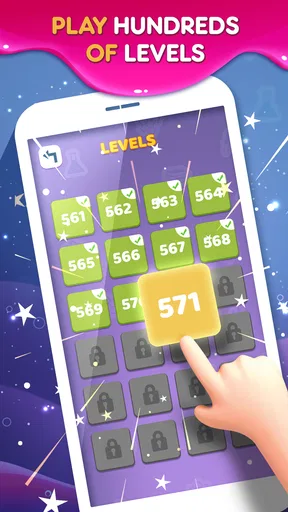
- Increasing difficulty provides a gradual challenge for puzzle fans.
- Offline play is convenient when no internet connection is available.
- Clean visuals and smooth controls keep the experience accessible.
Cons
- Later puzzles can feel repetitive after extended play sessions.
- Some levels may require trial and error rather than clear strategy.
- Ads may interrupt the experience
- especially between completed levels.
- Limited gameplay variety can reduce long-term replay value.
- Mistakes may force players to restart or undo several moves.
FAQs for Water Sorter
What is Water Sorter and how do you play it?
Water Sorter is a color-sorting puzzle game in which you pour layers of colored liquid between bottles until every bottle contains only one color. You can tap a bottle to select it and then choose another bottle as the destination, provided there is enough space and the top colors match. The rules are simple, but later levels require careful planning and several moves ahead.
Is Water Sorter free to download and play?
Water Sorter is generally available as a free download on Android and iOS, allowing you to play the main puzzle levels without purchasing the game. However, the free version may include advertising, optional in-app purchases, or paid features such as removing ads, receiving hints, or obtaining extra tools. Check the store listing for the exact pricing and purchase options on your device.
Does Water Sorter work offline?
Many parts of Water Sorter can usually be played without a constant internet connection, which makes it suitable for travel, commuting, or relaxing away from Wi-Fi. An internet connection may still be required for advertisements, cloud saves, analytics, updates, or purchases. If offline play is important to you, test the game after disabling mobile data and Wi-Fi because behavior can vary between versions.
Are there hints, undo options, or ways to recover from a mistake?
Water Sorter commonly provides helpful tools such as undo moves, bottle additions, or hints, although the exact selection depends on the version and level. These features can make difficult puzzles more approachable, especially when a move blocks a color you need later. Some tools may be limited, earned through progress, or offered through advertisements or optional purchases, so they should be used strategically.
Is Water Sorter suitable for children and what permissions does it require?
Water Sorter is easy to understand and generally appropriate for players who enjoy calm logic puzzles, including many children. Nevertheless, parents should review the advertising, in-app purchase settings, and privacy information before allowing unsupervised play. The game normally does not need access to sensitive device functions, but permissions and data practices can change between developers and updates, so verify them on the official app-store page.


